
Research
Research outputs

Conceptual paper
This note develops the concept of democratic anchorage as an analytical lens for assessing how administrative reforms contribute to the legitimacy of public governance. It expects that reforms are democratically anchored when they are designed and implemented in liberal-pluralist formats, i.e., participatory in design, inclusive and transparent in execution, and normatively aligned with widely shared democratic values. Rather than treating legitimacy as an automatic by-product of technocratic performance, democratic anchorage analyzes empirically the role of participatory structures, procedural mechanisms, and narrative justifications that “hook and bind” administrative change to democratic norms and structures. The concept of democratic anchorage is thus advanced as both a normative benchmark and a testable empirical framework for evaluating the legitimacy of public governance through administrative reform.

Report
Public administration reforms (PARs) are frequently justified by the expectation that they will enhance citizens’ trust in government and strengthen the legitimacy of political and administrative institutions. Yet, despite decades of scholarly and policy attention, systematic,
comparative, and empirical evidence on the relationship between PARs and citizens’ perceptions of legitimacy remains limited. This paper presents a systematic literature review of empirical studies examining how administrative reforms influence legitimacy perceptions, following PRISMA reporting standards. The review synthesizes findings from diverse reform contexts to assess whether and under what conditions such reforms bolster political trust and perceived legitimacy. By mapping the scope, direction, and conditionality of observed effects, the study identifies key evidence gaps and conceptual ambiguities.

Report
This Report presents first cross-national outputs of RADAR’s WP 3, which analyses
how European public administrations articulate reform, resilience, and democratic
principles in their official documents. WP3 builds a hybrid, multilingual analytical
system that combines large-scale corpus construction with NLP structuring, LLMassisted
reasoning, and systematic human validation. The resulting CLIO Library now
includes nearly 500 national documents and over 10,000 EU texts, allowing for the
comparative study of Romania, Belgium, and a preliminary Dutch corpus.

Report
This report introduces the novel database of Public Sector Innovations (PSI) in Europe that was developed as part of the RADAR project Work Package 2. The dataset entails 1710 cases of PSI across 42 countries and over two decades. Aside from being the first large database on PSI, it adds analytical value by applying the framework of democratic anchorage to the cases. This report entails visualisations of the content of the database, including mapping categories across time.

Report
This report summarizes the 2024 European Quality of Government Index (EQI), which measures institutional quality across 210 NUTS regions in all 27 EU member states. Based on a survey of over 135,000 citizens, the study maps regional performance in the quality, impartiality, and integrity of public services like health and education. By comparing data from 2010 to 2024, the findings reveal that regional governance is a key driver of economic growth and social trust, highlighting the necessity of sub-national data for effective EU policymaking.

Report
How does perceived bureaucratic performance shape democratic legitimacy? Drawing on the 2024 EQI survey of 135,000+ respondents in 210 EU regions, we study the link between evaluations of local administration (quality, impartiality, corruption) and two outcomes: vote intention for populist parties and abstention, using multi level logit models. Across all specifications, higher perceived quality of government is associated with lower support for populist parties. At the same time, improvements in perceived quality are linked to a modest rise in abstention. The findings underscore the importance of high quality subnational governance for democratic attitudes and behaviour but also point to a trade-off: improving administration quality may lower demand for anti systemic/populist parties but can also slightly depress participation. However, to the degree that this small reduction in turnout also implies decreasing demand for populist or anti-establishment options this is not necessarily a finding that is concerning from a democratic legitimacy perspective.
Visualisation
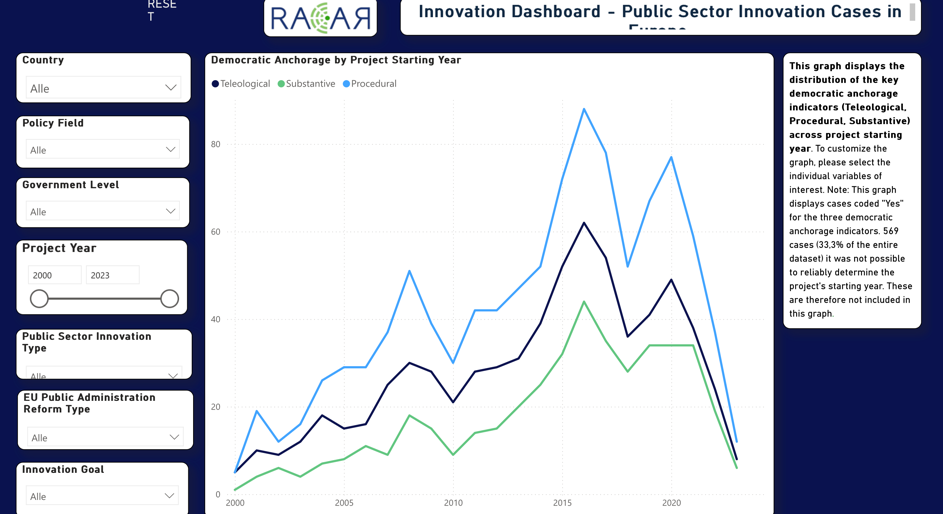
The RADAR Innovation Dashboard presents key insights from a new dataset of public sector innovations developed by the Hertie School as part of a work package for the RADAR project. The dataset covers 1,710 cases across 42 countries, over two decades, and across various government levels. Cases are drawn from several sources, such as best-practice datasets and public sector awards. The dashboard displays key information about the individual cases, including country, policy field, year of creation and level of government, and is available to the public via the RADAR website.
No results found.
Research highlights

The RADAR project had a successful kick-off event from 17-19 February 2025.
No results found.
What we do
The RADAR project combines
- rigorous research and analysis from top public administration research departments with
- the teaching and training infrastructures of (national) Schools of Government that will function as knowledge brokers
to bring science to policy through high-level conferences and to train public officials to foster innovation and reform while deepening democratic governance.